



In brief
At Generation, we produce detailed research roadmaps on sustainable shifts in industries to identify opportunities for investors and companies to drive positive change. Our Roadmap Series of articles highlights our key findings on a different industry each quarter. This second piece focuses on how artificial intelligence can impact US healthcare services – a sector where the potential reach of AI is profound.
At a glance:
- AI is collapsing the marginal cost of medical advice towards zero while the cost of medical action – the surgeon, the bed, the drug – stays stubbornly the same.
- As some costs come down, or as access improves, the demand for healthcare could explode.
- But, despite pockets of incredible healthcare, the system today is broken when viewed through the lenses of equality of access, medical debt, administration costs and error rates.
- We believe companies which employ AI to own what we call ‘health orchestration’ – the layer that joins the patient relationship, the proprietary clinical data and the authority to direct where finite physical capacity goes – can positively impact the healthcare system and have the most durable value.
Why are we focusing on healthcare AI?
In the 1960s, economist William Baumol famously noted that the number of musicians and the amount of time needed to play a Beethoven string quartet for a live audience have not changed in centuries, yet musicians in that decade made far more than Beethoven-era wages even when adjusted for inflation. He pointed out that because the quartet needs its four musicians, the group must raise wages to keep talent – to prevent its violinist from leaving music for a better-paying job.1
The result, which became known as Baumol’s cost disease, is that the price of human-delivered services rises relentlessly above inflation, even while the underlying activity barely changes. It takes a nurse roughly the same time to change a dressing in 2026 as it did in 1966, and yet it costs orders of magnitude more.
For 60 years, this has defined the cost trajectory of healthcare. AI is the first technology with a credible claim to reverse it, by reducing administrative waste and orchestrating how the system manages increasing access to care. That is why we are paying close attention.
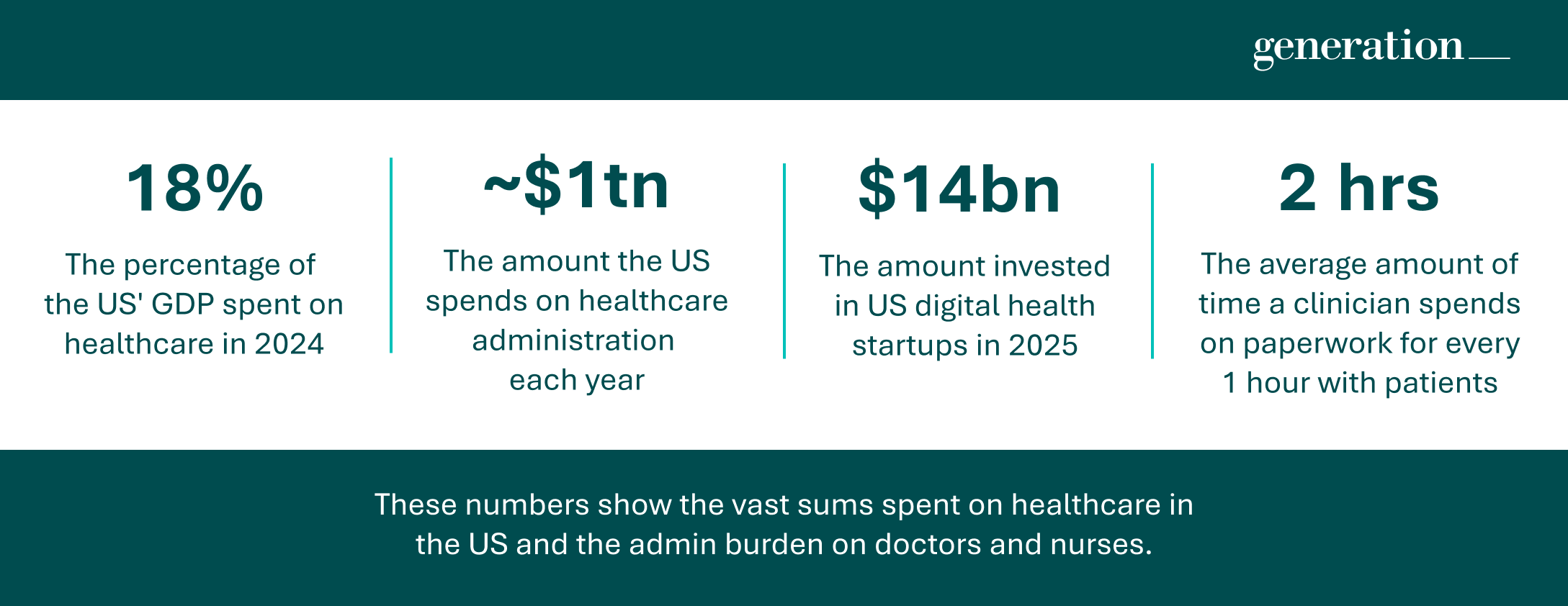
Healthcare accounts for about 18% of the United States’ gross domestic product (GDP), some $5.3 trillion in 20242, vs around 9% of GDP on average across countries in the OECD (Organisation for Economic Co-operation and Development).3 A striking share of that spend never reaches a patient. The US spends close to $1 trillion a year on healthcare administration and credible analysis suggests about $265 billion of that cost could be removed without compromising care.4
Increasing efficiency in admin would free up physicians to spend more time with patients. Doctors and nurses spend two hours on paperwork for every one hour of direct patient care, one US study found. That research also showed that physicians spend another one to two hours of personal time each night doing additional clerical work.5
We are starting to see real-world evidence that AI is having measurable impacts on healthcare admin. Our portfolio company Elation Health recently launched an agentic billing product that will support 90% of ‘touchless’ claims by the end of this year – meaning back-office staff can be repurposed into front-office roles. Another of our portfolio companies, AlayaCare, has launched a suite of agents that dramatically reduce the amount of human time spent on scheduling, verifying and billing for home care visits. While another of our companies, Chapter, delivers Medicare advice to American seniors via human-in-the-loop agents that are 3–5x more efficient than average.
Our thesis
Just over $14 billion was invested in US digital health startup companies last year – up from $10.5 billion in 2024 – and 54% of that total went to businesses offering AI services.6
The most obvious opportunity for companies in healthcare is automating the clinical and administrative work that already exists, but this space is also the most crowded. AI agents can take on prior authorisation, medical coding, clinical documentation and scheduling, and hundreds of well-funded companies are building into exactly these spaces. Ambient scribes have been the breakout category, with voice agents, chart review and clinical knowledge following closely behind. These are real improvements.
But reducing administrative spending with these technologies will not immediately reduce system costs, and reimbursed rates (the fixed fees or negotiated percentages that third-party payers like insurance companies or government programmes pay healthcare providers for medical services) are unlikely to come down in absolute terms. However, we do believe that once providers are able to halve their ratio of administrative staff to physicians, it will be much harder for them to argue for continued above-inflation increases in reimbursed rates.
In our view, there is a greater challenge at hand: the current system is so inefficient, so untransparent and so slow that new care models struggle to scale. It is our belief that only with better technology will new entrants be able to make a real dent in how care is delivered, and we are optimistic that newer care models should come with lower costs, or greater access, or both. We see early examples of this in companies such as Akido or Galileo: both are scaling new care models with materially better patient outcomes, and unit economics that open access to broader pools of patients. This progress would not be possible without integrating the latest technologies into care delivery and administration.
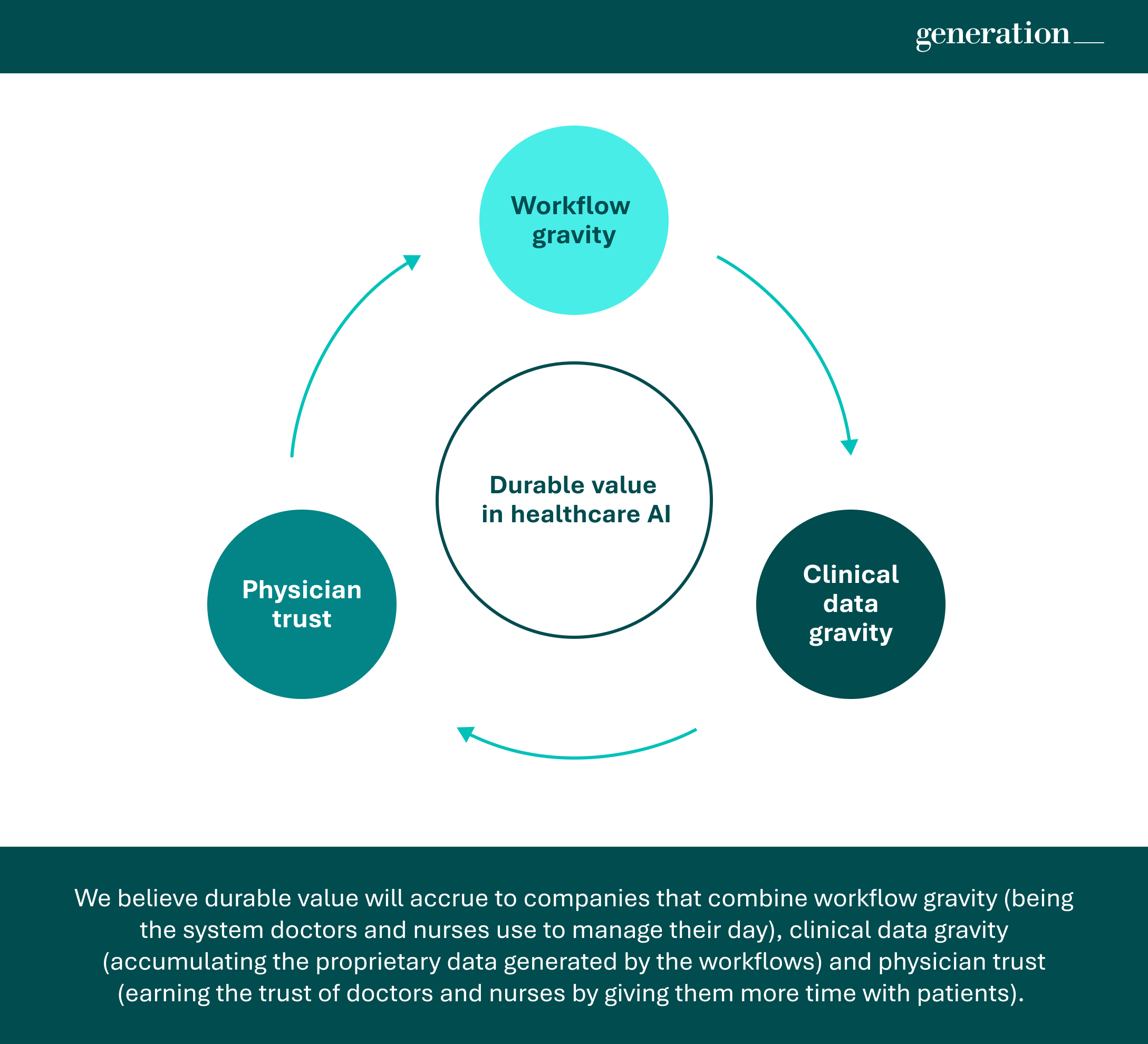
We have come to believe that durable value in healthcare AI accrues to companies that combine three things. The first is workflow gravity: being the system through which doctors and nurses actually run their day. The second is clinical data gravity: accumulating the proprietary data those workflows generate over time. The third is physician trust: earned by giving clinicians time back rather than trying to replace them. These then compound. The deeper a platform sits in the workflow, the richer its data; the richer the data, the more useful the AI; the more useful the AI, the harder the platform is to displace.
This is worth contrasting with how moats (the structural, long-term competitive advantage that allows a company to protect its market share) used to work. Providers had physical moats of facilities, location and reputation. Software vendors had workflow lock-in. Payers had capital and network relationships. AI reshapes all three. Many thin software point solutions are now exposed.
But the companies sitting at the system-of-record layer or bearing actual financial risk are harder to displace than ever, because the data loops those positions generate are exactly what make AI useful.
EHRs (Electronic Health Records) promised cost savings that largely did not materialise – primarily because they digitised existing workflows rather than reimagining them entirely. No ‘industrial revolution’ of the healthcare ‘factory’ has yet happened. Compounding this lack of reimagination is a relentless growth in complexity. We recently spoke to leaders at one academic medical centre in the US that employs 1,000 physicians, 2,000 nurses and 14,000 ‘other staff.’ They said there is a huge opportunity ‘above the EHR’ to bring a range of agentic solutions to both inpatient and outpatient settings.
Healthcare delivery is fundamentally a system of handoffs between digital and physical care, and miscommunication is often the source of inefficiency – the referral lost between physician and specialist, the patient discharged with no follow-up, the chronic condition managed across three settings with no single thread holding it together. A disproportionate share of healthcare’s cost and harm is generated at these handoff points. Managing the interface between the digital and physical worlds and steering the far greater volume of patient journeys that cheaper AI-enabled care could produce is what we call health orchestration. We mean something specific by the term: the decision-making layer for the patient journey – historically the preserve of the physician – is soon to be hybrid. This is economic authority to direct where finite physical capacity goes. We think augmenting it across a large share of patient journeys may ultimately be a great example of the sustainable trends we look for – better for the system (better utilisation of the physical capital expenditure), better for the patient and a business model with true network effects at scale.
We expect the AI labs to provide medical cognition, but we do not expect them to capture the value of it.
The labs are clearly winning on medical cognition. Google’s diagnostic system reached the correct diagnosis among its top 10 suggestions 59% of the time in a study of complex cases, versus 34% for unassisted clinicians,7 while OpenAI has launched ChatGPT Health and hired senior healthcare leadership.8 But being increasingly right about a diagnosis – although frontier models are still prone to hallucinations – is not the same as capturing the value of acting on it. That value flows to whoever holds the relationship and carries the risk. Assembling this full offering requires work the AI labs have shown no appetite for to date. Last-mile behaviour change needs physical-world feedback loops that cannot be run from a server room. You need boots on the ground to integrate solutions across thousands of provider organisations, each with its own record systems, payer contracts and credentialling rules. The most valuable clinical data still sits inside provider systems that are partly walled off. Escalation to a human clinician at the right moment is a regulatory necessity before it is a feature. The labs can supply the intelligence, but we think the durable economic value belongs to whoever orchestrates the physical system around that intelligence.
The abundance problem
AI does not lower the cost of medicine evenly. It collapses the cost of medical advice – the triage, the answer, the monitoring and the reminder – towards zero, because those are information problems a model can solve for everyone at once. But it barely touches the cost of medical action, because a procedure still needs a surgeon, an anaesthetist, a theatre and a bed.
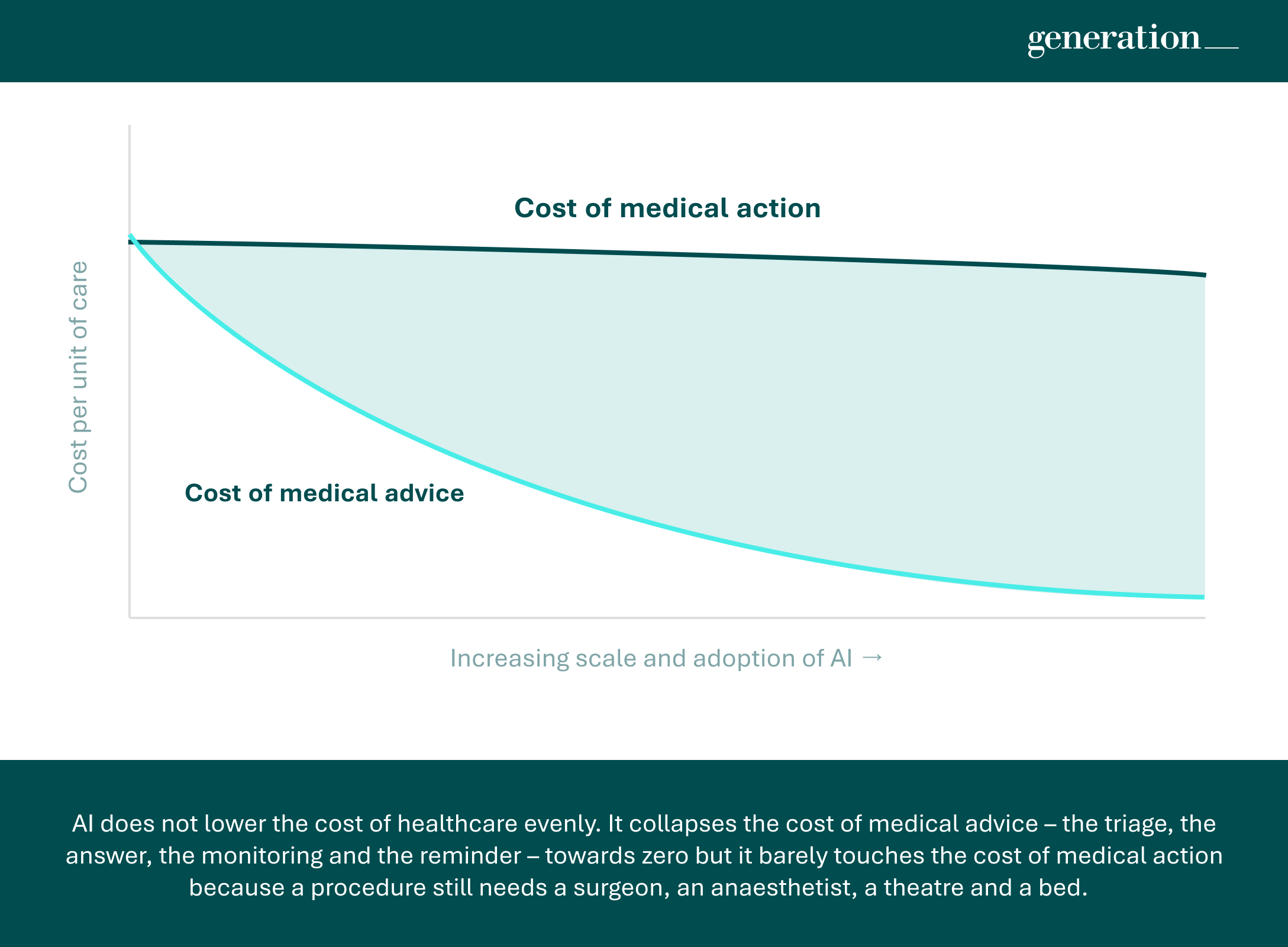
As the advice curve falls, demand that was rationed by the cost and inconvenience of seeing a doctor comes off the leash, and a digital front door can greet all of it at once. The physical system cannot answer at the same rate. The US has 2.7 practising physicians per thousand people against a peer-country average closer to 3.8, and roughly 2.8 hospital beds per thousand against a peer average above four.9 More than 100 million Americans already lack reliable access to primary care.10 The Lancet Commission on Global Surgery estimates that lower-income countries alone need 143 million additional operations every year that they cannot currently perform.11 It goes without saying that no AI model performs an appendectomy.
The real value sits in the widening gap between those two curves: the orchestration layer that meters near-infinite digital demand against finite physical supply and decides who is seen, when and by whom.
The surge in telehealth after 2020 mostly substituted for in-person visits rather than creating a flood of new ones because while the modality of the visit was streamlined, the availability of the human clinician and the physical system was constrained.12
So who will capture value from a surge in the usage of the healthcare system? We think it will be the platforms that manage the risk and route the patient, rather than those that merely sell software.
How we think growth-stage companies can win
Winning is about assembling a compounding loop of workflow, data and trust in a part of the system that is still up for grabs, wired to the economics of the scarce physical care it steers. Three approaches follow from that:
1. Focus on the outcome, not the software
We believe reimbursement, liability and data rights are precisely what the AI labs will not touch. The most durable position, then, is to stand behind an outcome rather than sell a tool that helps someone else produce it. There are companies in our portfolio that we believe are doing just that: Spring Health is paid to improve mental-health outcomes for a population rather than to license software; Chapter is paid to place an older American in the right healthcare plan and lives with the consequences when the match is wrong. Each turns the financial and regulatory machinery of healthcare from an obstacle into a moat, because clearing it is slow, physical-world work that a model cannot do for them.
2. Treat medical advice as the on-ramp, not the product
If advice is on its way to being free, a growth-stage company should use it as an on-ramp rather than sell the advice as a product. We believe the value is in the patient relationship that the advice opens, the proprietary record it generates and the escalation path to a clinician. The defensible asset is the loop, not the intelligence inside it. Another of our portfolio companies, Innovaccer, is a version of this at the data layer: unifying records across more than 80 million patients so that AI agents have somewhere trustworthy to run. The agents are replaceable, the unified record is not.
3. Make deep knowledge of the system your moat
We believe the AI foundation labs will shy away from the regulatory side of healthcare systems. This work is specific to a given payer, state or country, and requires deep knowledge of the regulations. Here, companies which understand the intricacies of the regulations will endure, we believe. With every contract signed, every system integrated and every regulatory pathway cleared, the company becomes more embedded and more irreplaceable. Our portfolio company Judi Health is a version of this approach: rebuilding the unified medical and pharmacy benefits engine beneath payers and employers, where much of the durable advantage is exactly the claims plumbing and regulatory work that nobody else wants to redo.
Looking ahead
Our Growth Equity strategy has invested behind deeply moated healthcare workflow and data businesses for years, and Doctolib, Elation Health, AlayaCare, Spring Health, Innovaccer, Judi Health and Chapter each sit somewhere on the journey from being a system of record towards becoming the AI-forward orchestration systems we think will prosper.
We believe the automation layer will keep attracting capital, but there will be a lot of ‘businesses’ that turn out to be features rather than enduring companies.
Our current thinking is that the durable winners are the companies that sit where the digital and physical worlds meet, holding the proprietary data, carrying the trust of clinicians and steering finite capacity towards the patients who need it most. If AI does break Baumol’s cost disease in healthcare, the constraint simply moves. It stops being the cost of advice and becomes the coordination of care. That is the layer we are investing behind, and we see an encouraging pipeline of companies forming for growth-stage investors who think the same way.
- NBER: W.J. Baumol, the ‘cost disease’ of personal services
- CMS: National Health Expenditure Data, 2024
- OECD, Health at a Glance 2025
- McKinsey: Administrative simplification: how to save a quarter-trillion dollars in US healthcare
- PMC: Tethered to the EHR: Primary Care Physician Workload Assessment Using EHR Event Log Data and Time-Motion Observations
- Rock Health: 2025 year-end digital health funding overview
- Nature.com: Towards conversational diagnostic AI
- OpenAI: Introducing ChatGPT Health
- Peterson-KFF Health System Tracker: How do US healthcare resources compare to other countries?
- NACHC: Closing the Primary Care Gap
- Lancet Commission on Global Surgery, 2015
- NIH: Evidence that post-2020 telehealth largely substituted for, rather than added to, in-person visits
Important information
The Roadmap Series: How AI Could Change Healthcare Delivery in the US report is prepared by Generation Investment Management LLP (“Generation”) for discussion purposes only. It reflects the views of Generation as of July 2026. It is not to be reproduced or copied or made available to others without the consent of Generation. The information presented herein is intended to reflect Generation’s present thoughts on sustainable investment and related topics and should not be construed as investment research, advice or the making of any recommendation in respect of any particular company. It is not marketing material or a financial promotion. Certain companies may be referenced as illustrative of a particular field of economic endeavour and will not have been subject to Generation’s investment process. References to any companies must not be construed as a recommendation to buy or sell securities of such companies. To the extent such companies are investments undertaken by Generation, they will form part of a broader portfolio of companies and are discussed solely to be illustrative of Generation’s broader investment thesis. There is no warranty that investment in these companies have been profitable or will be profitable. While the data is from sources Generation believes to be reliable, Generation makes no representation as to the completeness or accuracy of the data. We shall not be responsible for amending, correcting or updating any information or opinions contained herein, and we accept no liability for loss arising from the use of the material.